
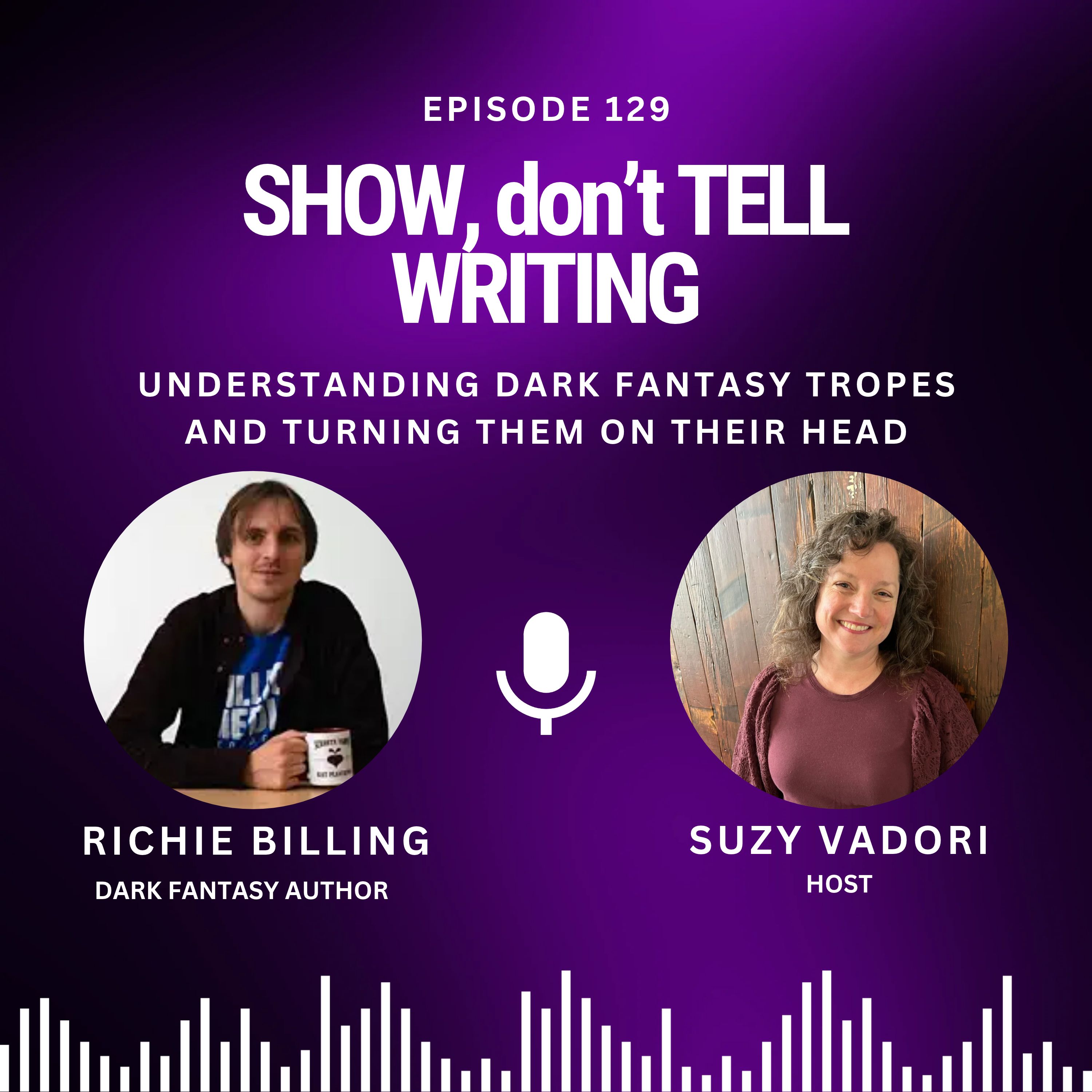
Show, don’t Tell Writing Podcast Show Notes & Links
- 📰 Sign up for the Inspired Writing Newsletter HERE
- 📝 Submit Your Page for our Show, don’t Tell Coaching Episodes
- 🌟 Leave a Review on Apple Podcasts (Thank you!)
- Intro and Outro Music is Daisy by Zight and used under a CC by 4.0 DEED Attribution 4.0 International license. For more music by Zight visit https://www.youtube.com/zight
Join Suzy as she chats with Dark Fantasy Author Richie Billing about:
• Blending dark fantasy and comedy, while staying true to the gritty, grim nature of the subgenre
• Serializing a story: how to create an online series, with a new chapter released each week
• Creating unique monsters and spinning classic fantasy tropes
• Writing dysfunctional characters and a chaotic crew
• Writing more lighthearted stories in our dark times
Mentioned in this Episode:
- Show don’t tell Writing Podcast: Episode #68. Fantasy with Richie Billing
- The Breakaways (volume 1)
- The Fantasy Writer’s Toolshed Podcast
🌟 Grab your spot in Suzy’s Inner Circle at www.suzyvadori.com/innercircle
Podcast Episode Transcript (unedited)
Suzy Vadori: [00:00:00] Welcome to the Show, Don’t Tell writing podcast with me, Suzy Vadori, where I peel back the layers of how to wow your readers with your fiction, your nonfiction. Anybody can bang out a first draft, but it takes a little more work to make your book as amazing as it can be. Join me as I share the step-by-step writing techniques you could apply to your writing right away as I host successful writers who share a behind-the-scenes look at their own [00:00:30] writing lives and as I live coach writers on their pages, giving practical writing examples that will make your own writing stronger.
Nobody is born knowing how to write an engaging book. There are real and important skills that you need to learn. On this show, I cut through the noise and get you all the info you need. I can’t wait to see how this information is going to transform your writing. Today we’re in for a treat, especially if you’ve ever been curious [00:01:00] about dark fantasy.
There are so many ways to discuss the genre, and today I’ve got Richie Billing coming on the show, which is really exciting because last year we did a show together about fantasy, which we’ll link to in the show notes. But today we’re gonna talk about a different kind of genre, dark fantasy. But we’re also gonna discuss what Richie’s doing, which is very cool, which is the serialization or releasing a chapter at a time to his Patreon community, and the way that he went about publishing this book is really cool.
The book that’s coming out, uh, the one that we’re [00:01:30] celebrating today on the podcast, is called The Breakaways Volume One. He describes it as The Witcher meets Terry Pratchett. It’s a new dark fantasy comedy. Listen to the way that he even says this. It’s so cool. It introduces a lovable crew of incompetent monster hunters in an adventure packed with gallows humor,
deadly creatures,
and found family.
Those are some of the things that we’re gonna talk about today is how do you combine dark fantasy and humor? So we’re gonna talk about writing humor, writing a series, how it’s all going, all of those [00:02:00] things. So if you’re interested in any of those things, this is the show for you. Richie Billing is a Liverpool-based fantasy author and host of the Fantasy Writers’ Toolshed podcast.
His fiction blends dark fantasy, flawed outsiders, and emotional stakes with sharp humor. He is also the author of Pariah’s Lament and Together We Rise, and has built an international community of fantasy readers and writers through his books, podcast, website, and his Patreon Welcome back to the [00:02:30] show, Richie.
So good to see you.
Richie B.: Well, thank you very much for having me back,
Suzy Vadori: Suzy. How are you doing? Good. Congratulations on your new, uh, your new book out. Exciting.
Richie B.: Oh, thank you very much. Yeah, it’s, uh, it’s been a, a, a more enjoyable experience writing this one because it’s more lighthearted, whereas last time when we were speaking about something that was like a critique of capitalism, which is very, uh, doom and gloom, and especially as, as the world’s progressively gotten worse since then as well.
Suzy Vadori: Yeah, fair enough. Fair enough. So it is [00:03:00] dark fantasy, your new book, The Breakaways, right?
Richie B.: Yes.
Suzy Vadori: We’re here to talk all about dark fantasy, and the reason I wanted to do this episode, last time we talked about fantasy in general. We’ll drop a link in the show notes so that listeners can go and check that out.
But I wanna talk about dark fantasy specific, ’cause it’s a really narrow genre, and it’s- Mm … one where I find writers are like, “Am I writing dark fantasy? What’s going on?” Mm-hmm. Like, what is that exactly? So-
Richie B.: Yeah …
Suzy Vadori: Richie, in your [00:03:30] terms, what would you consider dark fantasy?
Richie B.: I think dark fantasy for me is, it’s the, a, a sort of…
It’s very similar to like high fantasy, epic fantasy, all of that, but there’s just all sorts of sense in it. There’s like, it doesn’t stop, um, at, when it comes to like sort of violence, the swear words, and that’s what I kind of enjoy because it’s more expansive. You can sort of look at the grittier gray morally corrupted characters, and I find that more relatable because it’s more true to [00:04:00] life.
And you can delve into a lot of more sort of real world issues in a sort of rich fantasy setting at the same time. The stories tend to be a lot darker, a lot grittier, a lot like Game of Thrones. We’ve got The Lies of Locke Lamora. Joe Abercrombie’s books are very sort of gritty. But what I like about writers like Joe Abercrombie and Nicholas Eames when they’re writing these sort of, sort of violence, very gory stories, there’s still elements of humor and a lot of humanity in it as [00:04:30] well, which is quite a, a strange thing.
But yeah, I think that’s how I would describe it.
Suzy Vadori: Yeah, I love that. And also sometimes it has elements of horror in it. And do your books- Yes … have elements of horror in them as well?
Richie B.: I don’t go too much
Suzy Vadori: into the horror end. Not, not so much, but they can. Like dark fantasy- Yeah … can have that as well. But I love how you described it that, you know, it’s like epic fantasy except we go a little darker.
And I wanna talk about- I’m gonna talk about it in a minute, like how we balance that with humor, ’cause that doesn’t even [00:05:00] make sense to me in a second. Um, but first I wanna talk about the tropes, because one of the cool things about your book one in the Breakaway Series, where you say that it’s a crew of spectacularly useless monster hunters, right?
So like you’re already- Yeah … putting that sort of humor into the title, so we know what we’re in for, which is great. But you also really play with tropes. But I wanna address the tropes that you play with because you call this out in the press release. You talked about found family, [00:05:30] reluctant leader, dysfunctional adventure party, rival hunters, deadly guests gallows humor.
Like, can you just, for our listeners out there who are newer to writing, can you explain what a trope is and why these exist, and what you’re doing to, I assume, play with those tropes and not just be like, “Oh, I’m repatching everything that’s ever been done before”?
Richie B.: Yeah. I kind of, I mean, I’m not a big fan of tropes.
I don’t like sort of boxing things into easy sort of [00:06:00] definitions.
Suzy Vadori: Like- But so like cliches. They’re things that- Yeah … we see in writing all the time, right?
Richie B.: I feel like it’s more of a marketing publishing thing that’s like, oh, these books have all got chosen one heroes or things like that. And I think fantasy over time, a lot of sort of consistent tropes have popped up, and I sort of rebel against some of them because I don’t think, while they’re common in, in fantasy stories, people get bored of them.
But people like the sort of comfort [00:06:30] and familiarity of them. But like we were saying before with dark fantasy, you’re trying to sort of explore real world issues and things like the sort of old mentor figure. I don’t think that’s true to life because, I mean, my dad left my family when he, we were quite young, so I never had that sort of mentor figure, and for me it was a completely different experience growing up.
Um, so what was… It’s like that for a lot of people as well. So I feel like you can h- you’ve got a bit more freedom then [00:07:00] to, to explore them kind of things.
Suzy Vadori: Uh- Yeah. So these, these tropes that you list then, for marketing purposes, right? Do you sort of stand them on their head or do you actually have these things in there?
Or do you, w- how do you push the envelope?
Richie B.: Depends on the thing. So I like you tend to see a lot of tropes around in fantasy, like around race, like fantasy races. Mm-hmm. So we’ve got like goblins in, in one of the story, but like I… Tolkien goblins are the sort of trope, like these sort of slimy oaf fellas.
The king goblins. I
Suzy Vadori: love it.
Richie B.: [00:07:30] Yeah. But I like the goblins to be quite wit- like witty. They could be… They’ve got their own sort of detailed, rich culture, and when we see them they’re using magic and they’re using it quite successfully. So it just sort of spins things around and, and just keeps things fresh because, I don’t know about you, but if you just read the same thing over and over again.
Suzy Vadori: Oh no. Absolutely not. I mean, there’s going to be sort of norms or, or exp- expectations, reader expectations in every genre, but of [00:08:00] course we wanna keep it fresh and something that only you, Richie Billing, could actually write. Okay, so let’s talk about this for a second. You’ve got goblins, and in fact you write all sorts of different monsters, um, which I really admire by the way.
So let’s talk about this for a minute if you wanna have creatures in your stories, because a lot of my listeners do have that. Although I write fantasy, and I’ve gotta tell you that my last three outlines for books all included creatures, and then I never wrote the creatures, so I just didn’t do it. Yeah.
I’m super interested in human relationships and- Yeah … [00:08:30] I don’t have pets I don’t have a lot of experience with animals, so it’s something that I don’t write myself, but I’m fascinated by it. So talk about writing creatures or monsters. How is it different from writing people?
Richie B.: I like, this just sort of goes back to the dark fantasy side as well, because even though I want the story to be funny, I want the monsters to be really deadly serious.
These are dangerous things. Just take a s- s- like a slip, a trip on a, a rock, and you could be dead. [00:09:00] Um, and-
Suzy Vadori: Yeah, and I think you, you, you call them frightening monsters, right? Like, so these are not- Yeah … silly.
Richie B.: But I like to… But y- it’s quite funny, I find. I don’t know about you, but it’s mixing quite fantastical things with quite mundane things.
So it all, the story all begins with the crew getting the first contract, and it’s to kill this drake that’s moved into the area and is eating the farmer’s sheep.
Suzy Vadori: Hmm.
Richie B.: So they just need to go and deal with it ‘
Suzy Vadori: Cause the, the farmer sheep is sort of the mundane [00:09:30] thing.
Richie B.: Yeah.
Suzy Vadori: And then you have this, like, wild creature that’s in your imagination as well.
I love
Richie B.: it. So you have this little dragon that’s just flying around the forest, and they’ve just gotta go and chop its head off and bring the head back to get the bounty. But within that sort of-
Suzy Vadori: Poor little dragon.
Richie B.: I know, it’s quite touching.
Suzy Vadori: See why I can’t, see why I can’t write creatures?
Richie B.: Yeah.
Suzy Vadori: Um-
Richie B.: And yeah, so it’s like, that’s one of the best things about writing this particular story is because I really do like the monstrous side of fantasy.
Like, you can… That’s where you let your imagination run wild, [00:10:00]
Suzy Vadori: I guess. And do you ever let your monsters be the main character, or is it human interaction and then the monsters are truly monsters?
Richie B.: Well, yeah, there’s always a sort of, the monsters serve as the enemy. So as the story goes on, there’s different creatures that pop up.
Um, but in the sort of latest part of the story, which isn’t actually in the book, but it follows on, I have sort of twisted things around with the crew becoming, like, quite heavily [00:10:30] involved with a monster. I was gonna say- Hmm … but I’m trying not to give any spoilers away.
Suzy Vadori: Yeah, that’s, like, in a subsequent book.
‘Cause only book one in the series is out yet.
Richie B.: Yeah. How
Suzy Vadori: many books do you think there’ll be?
Richie B.: Well, I decided to write this with no intention of ever ending it.
Suzy Vadori: Oh, interesting. I love you. I know. I have no intention of ever ending this series.
Richie B.: Yeah.
Suzy Vadori: It’s like a never ending series. There was, um, a cartoon series once that my kids liked when they were little called Bo on the Go or something.
I think it’s Canadian. [00:11:00]
Richie B.: Yeah. And
Suzy Vadori: every answer was always like a never ending supply of something. And so I just am envisioning Richie sitting there with his notebook or his laptop and just continuing to write forever.
Richie B.: It’s quite fun. I mean, have you ever tried, like… I mean, this, this story starts out as a serialization, and I was just publishing a chapter a week on Patreon, and that’s one thing that I had to learn.
If you’d like to succeed on Patreon, you have to keep something like a series, something, like, regular to [00:11:30] keep bringing people back. So that’s how I got started. Yeah, people are
Suzy Vadori: gonna pay for a subscription, and they want something on the regular, right? Yeah. Like, I’m too slow a writer to be on Patreon because I’m, if I’m writing a book every three years, it’s not really gonna satisfy them very much, right?
Richie B.: Yeah, I know. It’s tough. But doing a short chapter a week, and what I tend to do is write the story in parts. So I, each part might have six or seven chapters, and they each follow on from each other, but it gives you, like, a little project, [00:12:00] not a mega- Like 60, 70,000 word novel, you can do 12, 15,000 words, move on, publish a chapter a week.
And then-
Suzy Vadori: Okay, so for the, so for the Breakaways, you were actually releasing those drafted chapters or do you polish them first? Yeah. You were releasing those to your Patreon, and then you, when you were done what you deemed to be a book, then you published it. Is that what you did?
Richie B.: Yeah. Yeah, exactly, yeah.
So what I would do is I’d draft it all [00:12:30] in one go, each part, and then when I get ready, I set a little schedule, and then edit one chapter a week before it goes out. And yeah, just develop it as it goes, and then when it was all ready, obviously went through the book, edited it again. But it was a lot nicer because you’d already edited it a few times before you, you got to that final stage.
So actually it’s quite a nice way to write, especially if you don’t like editing, ’cause you’re breaking it down
Suzy Vadori: into- You love editing. Who could not like editing? I’m just [00:13:00] joking, but I do prefer editing to, to first drafts. So how then, what’s the response been? Like you do have, uh, readers that were reading this chapter by chapter, and how did that- You know, how did getting that real time feedback feel?
And then did it, what were you able to do with that?
Richie B.: It’s, honestly, I, I much prefer it because when y- you write a novel, you said it takes you three years to write a novel- Yeah, it does … it’s very lonely. And-
Suzy Vadori: Very lonely …
Richie B.: [00:13:30] you don’t get any feedback. You don’t know if, if
Suzy Vadori: people like- Well, I work, I work with colleagues and- Yeah
my book coach and whatnot, but yeah. Yeah, I can imagine it’s really a rush to get it in the hands of readers, and to have people waiting for that next chapter is pretty exciting.
Richie B.: Yeah. And it’s nice because what I’ve been able to do is involve people in the story. So I have a few readers who, who will just like, they say as soon as it comes out, they’ll pick it up and start reading.
But I reward them by giving [00:14:00] them the chance to, like, make characters or name characters in the story, and that’s been one of the most rewarding things for me, and that’s one of the reasons why I decided to try something like Patreon, because you can have a more direct connection with your reader.
Suzy Vadori: Yeah, I love that.
Like, I was actually, um, at Bouchercon 2026 recently, which is a history thriller suspense convention, the worldwide convention, and I was on, I was in a panel listening to people talking about how they allowed, you know, or would put real people’s names in, in threads. And not just [00:14:30] let them name it, but actually name a character after them, and how all of their friends want them to kill them in print and things.
Yeah. It was really cool. Really smart. So will you, uh, will you let your Patreon members, like, cra- do you crowdsource the names, or is it, like, a prize that you get to name one character or one monster? How does it work?
Richie B.: Yeah, the prize way. It’s, I mean, it’s a good way to if- as, like, a writer, if you’re trying to grow an audience, do little giveaways and give away these opportunities [00:15:00] to get involved in the story.
It works really well.
Suzy Vadori: I love that. We’ll link to your Patreon in the show notes, and then people can check it out. Okay. So this particular book came out this fall, which you were saying, you know, it’s ideal for fall and Halloween season, but what makes The Breakaways dark fantasy as opposed to fantasy?
What particular elements, you were kind of talking in general, you know, that there’s more profanity or that there’s more danger, but what is it that you did here that makes it dark [00:15:30] fantasy?
Richie B.: I think it all comes down to the monsters, and I want the monsters to be really sort of… It’s not like Terry Pratchett monsters who sort of like-
Suzy Vadori: Yeah
Richie B.: they sort of puff fire at you, and you get a little eyebrow singed off. I want there to be consequences to everything, and that’s why I would sort of put it more in that sort of dark fantasy category. I want the reader to feel the grittiness of being a monster hunter, like having to deal with [00:16:00] the elements, trekking through forests, looking through caves, and seeing characters get hurt, and consequences to that.
Not shying away from the, the blood and the gore because,
Suzy Vadori: I mean- Yeah, that’s the horror element, right? And, and how… Do you have a body count in these books? Like how do… Do you kill a lot of characters- It’s one of my favorite chapters … or do they just get maimed?
Richie B.: The main characters- What can we
Suzy Vadori: expect?
Richie B.: don’t die. It’s more the sort of monsters and the injuries, and there’s… The last part is it’s about bog men, [00:16:30] and there’s this sort of remote town that’s like a, a… They’re all gold mining, and they’ve dug into the wrong cave and annoyed all these bog men, and-
Suzy Vadori: I love
Richie B.: it … they’re obviously mon- like monstrous, like the massive werewolves, but they’ve lost all sense of sort of humanity so they just absolutely just tear people apart.
So that was quite like a very visceral part of the story where there’s just like blood and gore, and it’s quite gritty and suspenseful. That, that’s what it is, but [00:17:00] more of a horror.
Suzy Vadori: I love that, and at the beginning you’re like, “Oh, really? Write horror?” Now you’re like, “Yeah, no, maybe, maybe there is an element there.”
I love it. But let’s talk about what actually makes a monster frightening. On this Show Don’t Tell podcast, we like to show people how we’re doing things. So, so when we say like that a monster isn’t just like happy-go-lucky, that it’s actually terrifying, what are some qualities or what are some techniques that you actually use in your writing to make a monster [00:17:30] scary?
Richie B.: For me, I, I always think you’ve gotta play on the fear of, on sort of the unknown at first.
Suzy Vadori: Mm-hmm.
Richie B.: Don’t wanna reveal it, what it is too soon.
Suzy Vadori: Okay.
Richie B.: And especially with the drakes. They find the drake in the cave, and it’s the sort of clues that they get. Like at first they were like, “Oh yeah, we hunted a drake ages ago and it was easy, and it was only a little drake.”
So it’s sort of playing it down already, [00:18:00] and then as they get closer to this cave, they see big track marks going in and out. They start finding carcasses of like cows as well as sheep within.
Suzy Vadori: So are we waiting for like a jump scare then? We see the track, we’re tracking it. Are we waiting? Is that the anticipation- So it’s-
that you use?
Richie B.: Yeah, it’s just sort of playing on the sort of senses of the… I always try and think about like if I was in the woods and if I was hunting, like I [00:18:30] like watching Bigfoot documentaries because it’s the sort of, it’s the ruggedness of being out in the woods at dark- Mm-hmm … or like at night. You can’t see- Probably
Suzy Vadori: in my neck of the woods, actually.
Richie B.: Yeah. There is Bigfoot watching. I think there’s been some sightings
Suzy Vadori: up
Richie B.: there. Yeah. Yeah. And um, it’s that sort of suspense and the tension that you’re trying, you want the person to f- the reader to feel as that character’s hunting that monster, and then the big reveal Um, and I think he’s always got a sort of, there’s always gotta be, [00:19:00] uh, a sort of an awe-inspiring moment where this monster sort of, you see it for the first time and then you’ve gotta make that reader feel like these guys are in trouble now.
Suzy Vadori: So from a show, don’t tell perspective, okay, we see a monster. I love that you’re showing us, right? And that tells me that you know what you’re doing. But we see the monster for the first time. So is that like 10 pages of description? Is it one detail? How do we go about that without getting long and [00:19:30] boring?
Richie B.: Oh, yeah. I, I mean, I’m not a fan of info dumps.
Suzy Vadori: No.
Richie B.: So you’ve gotta keep it progressing. Every, like, sentence, even every word when you’re describing something has gotta carry some weight. You can’t just throw adjectives in for the sake of it ’cause it’s just, you can’t follow what’s going on. So I think, feel like when you’re describing something and you’re trying to get quite a vivid picture in a reader’s mind, I like short sentences.
Maybe a, a couple of medium-length sentences just to keep the [00:20:00] rhythm. But I don’t… I mean, have you ever seen, you’ve probably seen some sort of old school writers where they’ll be describing a character or something like that and-
Suzy Vadori: Oh, yes, many. I read- … probably about four- … a lot of first
Richie B.: drafts. It’s my job
four or five sentence-
Suzy Vadori: Yeah …
Richie B.: like four or five line sentence. You’re like, “What? Can’t… Huh?”
Suzy Vadori: Yeah. I mean, you wanna, you wanna have the, you… I like to say give us a detail or two- Yeah … but then keep revealing it or keep building on it as we interact. I’m not sure if this is what you do, but this is what I teach.
As the [00:20:30] character’s actually interacting with them. So we don’t just stand there. I mean, we’re anticipating- Yeah … we’re tracking. We don’t wanna have the character standing back and watching and just observing the monster, but what are we doing, right? Like, what are their goals? Are they trying to get away from the monster?
Are they trying to fight the monster? Are they interacting with the monster? Like how, what are they actually doing? And then sort of- Yeah … dripping, like, a few gory details in between. Yeah. And using all of the senses. I like to say we don’t get to use [00:21:00] taste as often, ’cause I don’t want people going around licking the floor of the cave as they walk in, right?
Just to see what it tastes like. But the rest of the senses for sure, like- Do you smell? I would imagine smell is really key- Smell
Richie B.: is a great one, yeah … in monsters I have, um, these, they’re based on Bigfoots, but I call them the swamp people.
Suzy Vadori: Okay.
Richie B.: In Bigfoot stories, if you ever, like, see people recount them, the smell is a big thing.
Ugh, I would imagine. The smell is, the smell like death. It’s
Suzy Vadori: off-putting. Smell like death. Yeah. I love [00:21:30] that. Yeah. Yeah, because I think, I mean, here’s another show, don’t tell technique, right? Where people might say, “Oh, the smell was so off-putting she covered her nose,” or something. Well, well, give me a, give me an idea.
It smelled like death, right? Yeah. And then maybe you haven’t smelled the death of a human, but you’ve probably smelled something right along the way, and you know it’s rotten. You know it’s sour,
Richie B.: you know all of the things,
Suzy Vadori: right? Um-
Richie B.: Yeah …
Suzy Vadori: I love that. Super visceral, and it really taps into your reader’s experiences with other [00:22:00] things, and can really put them into that moment.
So I love it. And sound, too, right? Like, what does the mountain monster sound like? Are they trying to talk? Can they talk? You said you had talking goblins. Um, do they speak English?
Richie B.: Goblins were… Yeah, the goblins have, uh, ’cause I think I wanted the goblins to be quite funny. Okay. And I just like, I like the goblins, and there’s a bit of an interaction.
There’s a history with some of the goblins, uh, and so-
Suzy Vadori: Are they still frightening or just, they’re friendly?
Richie B.: They’re sort of, I [00:22:30] wanted them to be like, as you would imagine a goblin. But they’re a lot smaller, uh, a lot faster, more agile, and they’re quite sharp. So they’ll rove around in, in groups, and together they’ll do a lot of damage, and they’ve also sort of tamed these wild sort of underground monsters called cave moles, which can just sort of chomp through rock.
Suzy Vadori: So- So they’re kinda like a pack of teenagers, right? Like they’re-
Richie B.: [00:23:00] Yeah, exactly … they’re
Suzy Vadori: rowing around and getting into trouble. Um, they’re scary, but, but maybe a little bit tame. All right. So let’s talk about the humor, because like on the surface it’s such a tricky balance. It takes a talented writer, by the way, Richie, to be able to hold these two things being true at the same time, which is to have something be frightening and truly dark, and then also use the humor without diffusing all the darkness that you’ve done.
So [00:23:30] why do you do this? Why do you include humor into these books?
Richie B.: I feel like, like I said at the start, I just wanted to write something that was a bit of an escape from the grimness of the real world, especially after writing the last book. So I was pretty set on writing something that leaned into the humorous side.
And one of the first ever writing projects I did when I was quite young was with a f- a friend of mine, a very good friend of mine, Anthony Cumberl, and he ended up being a, [00:24:00] a very good comedian, and we wrote a sitcom together.
Suzy Vadori: Oh, nice. It was like- I did not know that …
Richie B.: It was like a lot of, it didn’t go anywhere, but we did all the script and everything.
We had it all planned. But it was very sort of slapstick in the sort of like what was going on in terms of like the actions. But it was very much based on our sort of experience of school. So we went to an all-boys school, and like, it’s, it was ruthless, like a battle for survival. But- [00:24:30] Wow … the humor was excellent, you know what I mean?
So, but like the witticisms, the banter, the back and forth, like the put downs, the practical jokes, and when we get together, we just have such a great time, just recounting-
Suzy Vadori: It’s the, just the speed and the pace of the language. I’m thinking like Gilmore Girls, but like an all boys, an all-boys cast, right?
Richie B.: You know. And like just to, I mean, some sort of references in terms of sitcoms that are a bit like that, Arrested Development- Mm … The Thick Of It, Veep, [00:25:00] these sort of incredibly fast back and forth comedies and yeah, that’s what I’ve, I really enjoy. I love it, all them kind of things.
Suzy Vadori: But is that what you put, I mean, so what kind of humor did you opt for in the Breakaway series?
Because, you know, is it slapstick humor or is it dark humor? Is it sarcasm? Is it like all of the above? What kind of humor
Richie B.: have you got? It’s, yeah, a bit of everything. But in the main, you’ve got four characters who are sort of kind of thrown together, and they all kind of [00:25:30] grate on each other a little bit.
They’re not very good, so they let each other down, and they’re all a bit wary. They don’t trust people generally, and y- I’ve kind of thrown them together, and this is the sort of found family element where as- Okay … time goes on and as they go through these things, as they, they go out of each other’s way to help and save each other They get closer.
Suzy Vadori: They- Do they, do your characters know that they’re funny? Like, does the main character or your point of view characters- No … do they think it’s funny? Or you just think [00:26:00] they’re frustrated or they’re annoyed in the moment, but the readers are gonna find it funny?
Richie B.: Well, we’ve got Hilda. Hilda’s the sort of, she just takes the piss out of everybody apart from Ben, who’s like the sort of leader.
Mm-hmm. So there’s Dudley and Lucas who are two simpletons of the crew, and they’re constantly, the three of them are sort of the main bickering force. And then there’s a, an older woman called Dalida. She’s a witch, so she’s a bit of a Karen. So she comes in and she just puts everyone down, and just… [00:26:30] I just like having lots of different characters and throwing them together.
So what I found quite helpful was thinking about, like, sitcom characters that I really like and find funny, and basing them loosely off each of the characters- Oh, I love that … in the story. So at least- I feel like you can liken them … you’ve got a reference, a reference point. And then as you write the story, and I’m sure you’ve found with your own writing, the characters just take a life o- take on their own lives and-
Suzy Vadori: They sure do
write the story. And by the end of the book you know them a lot [00:27:00] better than you did at the beginning, and then you gotta go back and make your chapter one match, and that’s, that’s the rub, right? Yeah. Okay, so I mean, how do you test this humor? Because I’ve worked on a number of books. I don’t write humor myself, but I’ve coached it a number of times, and one of my jobs as an editor is to react to things and to tell them when it doesn’t work on paper.
Because especially things like, you know, when we deliver things like as a stand-up comedian or in person- Yeah … people tell me I’m funny. I don’t write funny. I once ran into someone that I went to university [00:27:30] with, and he said, “I can’t wait to read your books and see your biting humor in it.” And I was like, “Oh, the…
No, my book sucks.” Because I think it’s really hard to convey in print- It is … what we can with intonation and timing and all of those things, especially sarcasm. So how do you make sure- Yeah … that what sounds funny in your head actually works on the page?
Richie B.: Yeah, I mean, it’s a really good point. And I dunno if you’ve ever found this when you write, you’re reading sort of supposedly laugh out loud funny [00:28:00] books-
Suzy Vadori: Yeah, LOL
don’t, don’t, don’t laugh- We don’t put LOL in novels …
Richie B.: yeah. But you don’t really laugh out loud. No. You might be smiling. You might, you just find- You might snort. There’s been a few times where I’ve been like, oh, like laughing, but it’s more of like a, a joke mixed with an emotion, like something’s happened.
Um- Mm-hmm … so I don’t really, I’m not like, I don’t f- I feel like it is really hard to write comedy on paper. I just think it’s, it’s- It’s,
Suzy Vadori: yeah, and especially sarcasm [00:28:30] because sometimes you just take it, readers, if you didn’t, they don’t have the clue. You know, we don’t wanna say, “She said sarcastically,” ’cause that’s like really lazy on you.
But, but sometimes you have to call it out somehow, or you need to use italics for intonation or for emphasis just to, just to- Yeah … make it land. And sometimes it just doesn’t land at all.
Richie B.: I know. I, it’s the risky run and especially ’cause I’ll, I rely on, not a lot, but like dialogue is the main form- Mm-hmm
of comedy here, [00:29:00] and you lose a, a bit with the delivery, the timing of things, like you said, and you just gotta sort of write it in the best way you can.
Suzy Vadori: Yeah.
Richie B.: Whilst, like if you said- And have
Suzy Vadori: your character react and your character’s reactions-
Richie B.: Yeah …
Suzy Vadori: to it sometimes can be the best thing.
Richie B.: Yeah. And I think that’s why you can go a little bit more slapstick in books, like characters, they’re j- just walking along and they just trip over and crack their nose, and now they’ve got a bloody nose.
I mean, just like stupid things like [00:29:30] that for as long as it all sort of ties in and it’s not just- Just make it all
Suzy Vadori: hard
Richie B.: for them … the wrong, the, the, the cheap, cheapness of a laugh. You’ve
Suzy Vadori: gotta have- Yeah, ’cause I mean, how do you, how do you have slap, like slapstick and dark and the city sounds are like so intriguing.
If you like slapstick and you also like dark, Richie’s book is for you. But how do you decide, like how do you balance that? Is it only certain characters that get those punchlines? I mean, we don’t want a Jar Jar Binks that’s going around and making everything- … kind of like lighthearted supposedly, but then becomes [00:30:00] annoying, right?
So how do you ba- how do we balance that?
Richie B.: I think it, uh, it comes back to what we said there about time and gotta pick your moments for these things. Like- Mm-hmm … there is, when you’re writing first draft, sometimes, like I’ll, I’ll have characters in, there’d be like a really serious situation, but there’ll just be like a funny line that will pop into my head and a character will say it.
And then when you go back and edit and it’ll be like, this is quite jarring. Mm-hmm. At this point in time- This isn’t it … this just doesn’t work.
Suzy Vadori: So it’s- It [00:30:30] diffuses tension, right? So like it’s hard to create suspense and tension and also have humor, so you’ve gotta pick your moments. Yeah.
Richie B.: Yeah. So if there is-
Suzy Vadori: Kill your darlings, Richie.
Love that. If you love that line, but it just doesn’t work, take it out, right?
Richie B.: Exactly. Yeah. ‘Cause like we’re saying, we’ve gotta, it’s dark fantasy, but it’s a comedy as well, so you’ve gotta stay true to the, the dark fantasy elements which are the sort of bloody, gory action moments. Otherwise you do run the risk of pissing all them fans off.
Yeah. Um, [00:31:00] and then you’ve gotta then inject the comedy where it’s a little bit mundane or quiet or where the moments are right. So that’s what I would say. Pick your battles.
Suzy Vadori: Amazing. Okay. And you have a series planned that’s gonna be never ending. What are you gonna do next? What about the next like six months?
What’s
Richie B.: the plan? So yeah, I’m just wrapping up, um, the draft of- The, the next part of this, uh, the Breakaways, which ends up being half the length of the whole f- [00:31:30] volume one. So-
Suzy Vadori: Yeah.
Richie B.: I mean- … there’s been plenty coming out for the next few months. And then I’ve edited… Oh, I’ve, I’m just editing a novel that I’ve drafted, a short fantasy novel, which it’s a bit like, a bit of a John Wick-y kind of action.
Suzy Vadori: Okay.
Richie B.: Yeah. About, uh, a sort of war hero who’s wa- trying to get home to his wife and his, his two daughters, ’cause he’s not heard from them for, like, 18 months. He feels like there’s something going on, and he, he’s trying to get home, but it feels like the world’s trying to stop him. So [00:32:00] it’s, uh, more of an action based…
It’s more commercial, let’s say.
Suzy Vadori: Yeah. Well, you have a lot of projects on the go, and that’s exciting, and, and, you know, now that you’ve committed to never stop the Breakaways, um, you’re gonna be really, really busy. How do you keep the world fresh when you’re writing in a world for a while? How do you keep the world fresh for books, you know- Yeah
two through infinity?
Richie B.: That’s it. You’ve gotta look at the exploration, really, ’cause that’s one of the reasons why in the, the fifth part I was like, “This needs to be different.” We’ve had, [00:32:30] what, like, 30, 40,000 words of going through forests and caves.
Suzy Vadori: Yeah.
Richie B.: Right. So we need to get out of here.
Suzy Vadori: Yeah.
Richie B.: Please. You just kind of feel a little bit bored yourself when you’re writing it, and you’re like, “Oh, that’s going…”
So then in the next part they go to this mining city, which is like a… It’s a massive pit, basically, that, uh, they just never stop digging for- Yeah … like, hundreds of years. It just keeps going. There’s tunnels that stretch miles, and as caves have been abandoned, people have [00:33:00] moved into them. So there’s this-
Suzy Vadori: I wish the listeners could see your face.
You’re, like, lighting up as we’re talking about mine town.
Richie B.: Well, that’s the best thing about fantasy, isn’t it? You just get to go, “All right. We need to go somewhere else. Let’s see what we can think of,” and-
Suzy Vadori: Yeah. Absolutely … that’s what it is. You know, like, I, I used to think when I was first starting out that book two would be so much easier ’cause you’ve already created the characters and the world, but book two is so much harder because you’ve already created the characters and the world, so you can’t just rehash that.
So yeah- Yeah … one of the techniques to do in subsequent [00:33:30] books is to change location. Yeah. Now, a lot of times I see a first draft where- Especially in fantasy where writers think of all these things up front, and then the first half of the book is just their characters going around exploring different, different areas of their world with nothing happening.
So that’s the other extreme. But typically, yeah, keep it tight and then keep expanding, and keep expanding your character base. In your case, do you have new monsters, for instance, in every single book, right? Like, how do you, how do you keep [00:34:00] expanding that world and showing us different corners of it and having those adventures happen in different corners with different characters, different timeframes, different
Change something, ’cause if you don’t, you’re gonna be rehashing a lot-
Richie B.: Yeah … from your first book. And it, it can be a problem, especially when you’re doing your first drafts where you’re like- Yeah … this, this just feels a bit familiar, and there’s only so many times that you can have your characters go looking for a monster in the woods, end up in a cave-
Suzy Vadori: Yeah
Richie B.: exploring in the dark [00:34:30]
Suzy Vadori: Yeah, and you’re like, “Wait a minute, I wrote this already.” And it’s great. It’s hard when you love something, especially if it wasn’t published yet, um, you find yourself in those things. And so yeah, definitely keep it fresh. I like to also, when I’m coaching writers in the series, each book might actually have a different reader takeaway, like what, what is the point that you’re trying to make with your book?
Oh, yeah. And that can help keep it fresh too because even if it’s in the same situation, if it’s the same characters or if it’s different characters, maybe they have different [00:35:00] goals, right? So they might react completely different even though the situation feels similar. They’re not the same human or they’re not the same monster that they were when they went through the trials and tribulations of book one.
So you can actually keep it fresh that way.
Richie B.: Definitely, yeah.
Suzy Vadori: Amazing. Okay. Richie, we have reached the quick-fire portion of this podcast, and we’ve answered these questions together before. Definitely go and check out our first interview, which was on fantasy in general. Yeah. But okay, these are gonna be specific to The [00:35:30] Breakaways.
Mm-hmm. So how long did it take you to write this book, from the time you imagined it was a good idea to the time that you bound and published it and sent it out to readers beyond your Patreon?
Richie B.: It was about 18 months. So like I said, I started as a serialization, uh, and I was releasing a chapter a week, and then I’d have a little break while I wrote the next part of the story, and then
So over about 18 months. It was about 50, 60,000 words.
Suzy Vadori: Okay.
Richie B.: Um, [00:36:00] yeah, so it was quite a nice way to … ‘Cause you’re editing as you go.
Suzy Vadori: Yeah. No, and, and I love, love, love that you’ve involved readers. It’s like a choose-your-own-adventure or like a collaborative or interactive type experience. Okay.
Richie B.: Yeah.
Suzy Vadori: What was your first big break when you were doing this where you’re like, “Okay, this is gonna work and I’m excited.
I’m gonna do this series forever”?
Richie B.: I just remember getting a, an email randomly. Every now and then you just get like a random email from somebody, and they’d be like, “When’s the next, uh, Breakaways [00:36:30] coming out?” Oh. And I’d be like, um, oh, I, I’ve just basically given them the spiel, and they never actually turned around and said that they liked it.
And this is one of the things that-
Suzy Vadori: That was implied. They were showing you that they liked it, Richie. I’m sure they did that-
Richie B.: Exactly, yeah … they wanted you to know. So this is what I mean. I was just like, people want more of it, so I’m just gonna keep going because- Yeah … people seem to like it, and that’s what, that’s what you hope for as a writer, that you just get some kind of response.
And some people just literally, like [00:37:00] especially men, I’ve found, they won’t say, “Oh, yeah, I really like this character,” or, “I really liked what happened.” It’s like,
Suzy Vadori: give me
Richie B.: more. They just say, “Yeah, when’s the next one out?”
Suzy Vadori: Yeah. So that’s good though. And you know what? That’s a really good thing for our listeners to hear though.
You know, if you’ve already published your own books, you maybe know this already, but maybe you think that those of us who publish books and maybe sell more than you or something don’t care about our reader feedback. We do. We need, we need that. Um, so yeah, dropping a line to your, whether it’s a formal [00:37:30] review or an email, or just letting the writer know that you appreciate the time and energy and that you enjoyed their work is like, it means the world to us.
I never get tired of those email, ever. Okay. What’s your best advice for listeners out there who are writing dark fantasy or who are considering writing dark fantasy?
Richie B.: I would read a lot of books in the genre.
Suzy Vadori: Yeah.
Richie B.: Um, so like Mark Lawrence, Lies of Locke [00:38:00] Lamora, um, is a great dark fantasy book. There’s quite a lot of, I mean, Christopher Buehlman is writing a lot of brilliant dark fantasy at the minute, and just see how they do it, and get an idea for the spectrum of darkness, I suppose.
Suzy Vadori: Yeah.
Richie B.: Um, so I wouldn’t say, like, I’m always, like, quite… ‘Cause you’ve got like grim dark, which is probably like the really heavy dark fantasy, which is like Joe Abercrombie. So yeah, have a, have a read of all these different books. Get a feel
Suzy Vadori: for- And read recent books, right? I mean, these [00:38:30] things, uh, uh, genres and genre expectations change over time.
Yeah. So if you’re, you know, if you’ve read Lord of the Rings and you wanna write like that, it probably wouldn’t get published today. It’s br- brilliant. I’m not diminishing its brilliance, but it’s been done. So what’s being done now?
Richie B.: Um- I feel like horror fantasy is quite popular.
Suzy Vadori: Mm-hmm.
Richie B.: So it’s gone to the more extremes.
So yeah, definitely have a little read, and like you said, keep an eye on like what’s coming out now. There’s like The Dark Fantasy [00:39:00] Magazine and a few other publishers that just do nothing but dark fantasy. So have a little look and see what kind of stories they’re putting out.
Suzy Vadori: Yeah. Yeah. Absolutely, and get inspired and make it your own.
Awesome and amazing. Where can we find you and your work?
Richie B.: Uh, best place to go is richiebilling.com. Uh, I’m also on Patreon, just search for my name again. I’m easily found.
Suzy Vadori: Awesome. Thanks so much for coming on the show again. It was great to talk about dark fantasy.
Richie B.: Oh, thank you very much, Suzy. Lovely to speak to you as always.[00:39:30]
Suzy Vadori: Thanks for tuning in to the Show, Don’t Tell writing podcast with me, Suzy Vadori. It is my absolute honor to bring you the straight goods for that book you’re writing or the book that you’re planning to write. Please help me keep the podcast going by helping people find us. You can subscribe to the podcast and leave a review on Apple Podcasts, Spotify or wherever else you’re listening to show how much you enjoy the show.[00:40:00]
That’s how other listeners will find us. Also, visit Suzyvadori.com/newsletter to hop on my weekly inspired writing newsletter list, where you’ll stay inspired and be the first to know about all the upcoming training events and writing courses that happen in my community. Want my eyes on your writing?
Submit a page of your current draft for a chance to come on the podcast at the link in the show notes. I’d love to chat with you about your writing in my always positive, incredibly supportive way so that [00:40:30] you can make great strides towards your writing goals. I’m here to cheer you on. Remember, that book you’re writing is gonna open doors that you haven’t even thought of yet, and I can’t wait to help you make that it the absolute best it can be.
See you again right here next week